
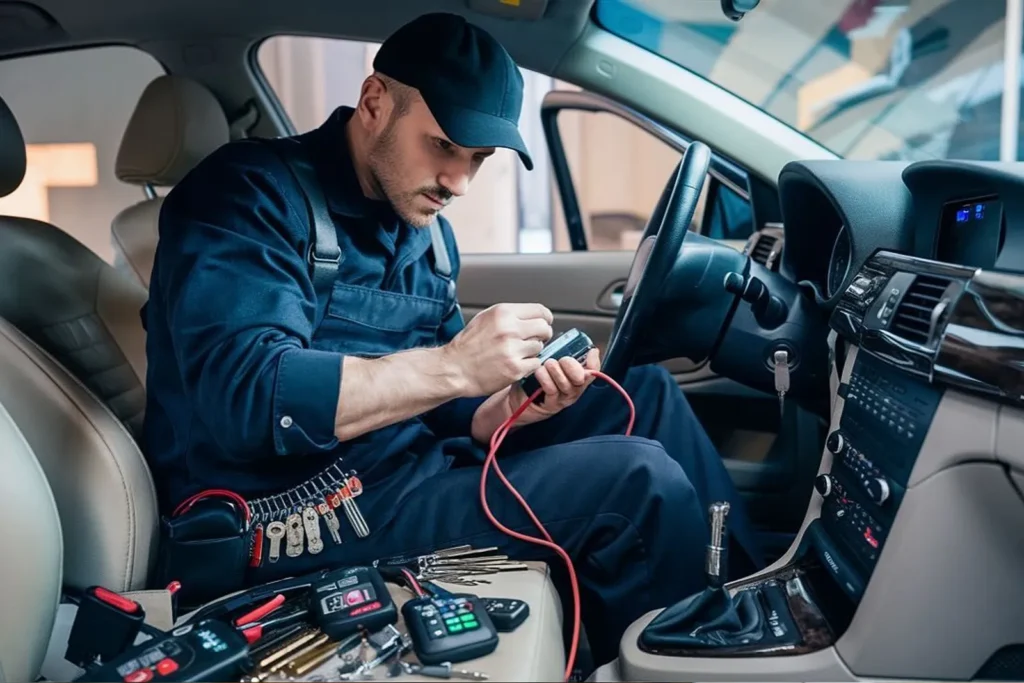
Car lockout services are often what you need when your car key fob works all week, then suddenly quits in a parking lot. One morning, your doors unlock from across the street. That same afternoon, you stand beside your car, pressing the button over and over, but nothing happens.
It feels random, and that is what makes it so frustrating. A completely dead fob is easy to diagnose, but a car key fob that works only some of the time can leave you guessing.
The good news is that intermittent key fob problems almost always have a cause. Most are simple, a few are less obvious, and some are a sign that you should stop waiting and get help. Let’s explore the most common causes and how to identify them.
How a Key Fob Actually Talks to Your Car
Before we get into what goes wrong, it helps to know what is supposed to happen. A key fob (also called a remote key or keyless entry remote) is a tiny radio transmitter. When you press a button, it sends a coded radio signal to a receiver inside your car.
That code is not the same every time. Most modern fobs use a rolling code, which means the code changes with every press so a thief cannot simply record it and replay it. Your car and your fob stay in sync by following the same pattern.
A smart key, sometimes called a proximity key or keyless entry fob, goes a step further. It constantly exchanges short signals with the car, so the doors unlock when you walk up with the fob in your pocket. This is why a weak signal can cause trouble even when you are not pressing anything.
So what does that mean for you? Any weak link in the chain, from the battery to the circuit board to the car’s receiver, can make the fob work one moment and fail the next.
The Most Common Reason: A Weak Key Fob Battery
If your fob works only when you are close to the car, or only after a few tries, the battery is the first suspect. Many fobs run on a small coin cell battery, and the exact type depends on your vehicle. Your owner’s manual will tell you which one yours uses.
The tricky part is that a battery rarely dies all at once. As it weakens, the signal gets shorter and less reliable. Think of a flashlight that dims before it goes out. The fob still “works” but only under good conditions.
Here are signs of a fading battery:
- You have to stand closer to the car than you used to
- You need to press the button several times
- The fob works in the morning but not later in the day
- A warning message appears on the dashboard
- The small indicator light on the fob looks dim or does not flash
Replacing the battery is usually quick and inexpensive. Just be careful when you open the case, because the fob’s circuit board is delicate. If you pry too hard, you can create a bigger problem than the one you started with.
Signal Interference: When the Problem Is Outside the Fob
Here is a practical example. Your fob works perfectly at home but fails in the parking garage at work, or near a big hospital, an airport, or a cell tower. That pattern points to radio frequency interference, which is just other signals competing with your fob’s signal.
Your fob uses a low-power radio signal. Strong signals from nearby equipment, metal structures, or even other electronics can drown it out. Dense metal and concrete in parking structures can also weaken the signal.
Try this simple test. If your fob works fine after you move the car or walk to a different spot, interference is likely the culprit. It is annoying, but it does not mean the fob is broken.
Also check what is sitting next to the fob. Keys crowded next to a phone, a magnetic item, or a bulky bundle of other fobs can sometimes interfere with the signal or wear the case down faster.
Worn Buttons, Cracked Cases, and Dirty Contacts
A fob lives a hard life. It gets dropped, sat on, tossed into bags, and shoved into pockets with coins and keys. Over time, the physical parts wear out.
Inside each button is a small contact pad that touches the circuit board when you press it. When that pad wears down or gets dirty, the button may work only at certain angles or only with extra pressure. If one button, like “unlock,” fails while others work fine, wear is a strong possibility.
A cracked case is another quiet problem. Even a small gap lets in moisture and dust, which can corrode the metal contacts. If your fob works fine on dry days but acts up after rain, humidity may be getting in.
Water Damage and Corrosion Inside the Fob
Have you ever washed a fob by accident, or left it in a jacket that went through the laundry? Even if it seemed to dry out and work again, the damage may still be there.
Corrosion is the slow rusting or buildup that happens when moisture reaches metal parts. It can cause a poor connection between the battery and the circuit board, which leads to that classic “works, then doesn’t” behavior. Sometimes it works when the fob is warm and dry, then fails when it cools down.
If you suspect water damage, take the battery out, let everything dry fully, and do not keep pressing buttons. A professional can inspect the board and tell you whether it can be saved.
Fob Programming and Sync Problems
This is where things get a little more complicated. Sometimes the fob and battery are fine, but the car no longer “recognizes” the fob properly.
Remember the rolling code? If the fob and car lose sync, the car may ignore the signal. This can happen after a battery change, after the car’s own battery has been disconnected or replaced, or after the fob is pressed many times while out of range.
In many vehicles, a quick reprogramming or resync can fix it. Some models let you do this yourself using a specific sequence of steps in the owner’s manual. Others need specialized programming equipment, which is where a locksmith with key programming tools can help.
For vehicles with a transponder key, which contains a tiny chip that talks to the engine’s immobilizer system, a different issue can appear. If the chip is damaged or not reading well, the key may open the door but fail to start the engine.
Problems Inside the Car Itself
Not every key fob problem starts with the fob. Your car has its own receiver, antenna, and battery, and any of them can create the same symptoms.
A weak car battery is a common hidden cause. When the battery is low, the electronics may not have enough power to respond reliably. If your fob problems started around the same time as slow cranking or dim lights, check the car battery too.
Aftermarket electronics can also interfere. Remote starters, alarm systems, and plug-in devices that were installed incorrectly sometimes disrupt how the car listens for the fob. If the trouble started right after something new was added, mention it to your technician.
When Fob Problems Call For Car Lockout Services
Intermittent problems are often a warning sign. You can get away with a flaky fob for weeks, until the day it fails when it matters most. That is how many people end up needing car lockout services at the worst possible moment.
Consider the situation. You step out to put gas in the car, close the door out of habit, and realize the fob is inside. Or the fob refuses to unlock a car with the key still in the ignition area. Without a working fob, you may feel stuck.
A professional locksmith can handle this in several ways, depending on the vehicle:
- Non-destructive entry. Specialized tools open the door without scratching paint or damaging weatherstripping.
- Key fob replacement. If your fob is lost, damaged, or beyond repair, a locksmith can cut and program a replacement.
- Fob programming and repair. Resyncing or reprogramming can sometimes restore a fob without buying a new one.
- Transponder key services. Programming a new chip so the car recognizes the key and starts normally.
If a child or pet is locked inside a car, especially in warm weather, call 911 first. That is an emergency, not a lockout.
What You Can Do Right Now If Your Fob Is Acting Up
You do not have to wait for a total failure. These steps are safe and often useful.
- Replace the battery. It is the cheapest and most likely fix.
- Try the mechanical key. Most fobs hide a small physical key inside. Check your manual for where it is and how to use it.
- Use the backup start method. Many push-button cars let you hold the fob against or near the start button when the fob battery is weak. Your manual will explain the exact method for your model.
- Test from different locations. This helps you rule out interference.
- Check the car battery. Weak power can mimic fob failure.
- Look for a spare. If the spare works and the main fob does not, the problem is almost certainly the fob itself.
That last test is a useful clue. When the spare fob works perfectly, you know the car is fine. When both fobs act up, look at the car’s receiver or battery.
Mistakes to Avoid With a Failing Key Fob
A few common choices make things worse.
Waiting until it stops working completely. A glitchy fob is a warning. If you have only one fob, replacement and programming take time, and you do not want to be stranded while you wait.
Prying the case open carelessly. Cracked plastic and bent contacts turn a cheap battery swap into a repair.
Buying a random fob online without checking compatibility. Fobs differ by make, model, year, and frequency. A wrong fob may look right but never program.
Assuming the dealer is the only option. Many people do not realize that a qualified automotive locksmith can often cut, program, and replace keys and fobs for many makes and models, often without towing the car anywhere.
Fix the Fob Before It Leaves You Locked Out
A key fob that works sometimes and fails other times is usually trying to tell you something. It might be a fading battery, interference, worn contacts, moisture, a sync problem, or something in the car itself. Start with the simple checks, and do not ignore the pattern if it keeps coming back.
If you are already locked out, or you would rather fix the issue before it becomes an emergency, reach out to AZ Locksmith and Key Solutions. We provide professional car lockout services, along with key fob programming and replacement, backed by technicians who understand how modern vehicle keys really work. Call +1 (310) 844-2365 or visit https://azlocksmithsonline.com/car-lockouts/ to learn more about how we can help you.
Frequently Asked Questions
Why does my key fob work only when I am close to the car?
That usually points to a weak fob battery. Replace it first. If the problem remains, interference, corrosion, or a worn circuit board could be responsible.
Can a dead car battery stop my key fob from working?
Yes. A weak car battery can prevent the receiver and electronics from responding properly. If the fob works on a spare or after a jump start, the car’s power was likely the issue.
Do I need to reprogram my key fob after changing the battery?
Often no, but it depends on the vehicle. Some fobs lose sync, especially if the car battery was also disconnected. Your owner’s manual or a locksmith can confirm whether reprogramming is needed.
Can a locksmith replace a car key fob?
In many cases, yes. A qualified automotive locksmith can cut and program replacement keys and fobs for many vehicles.
What should I do if I am locked out with my fob inside?
Stay in a safe place and call a professional. Avoid forcing the door or using tools to pry it open, since that can damage the lock, window seal, or door electronics.